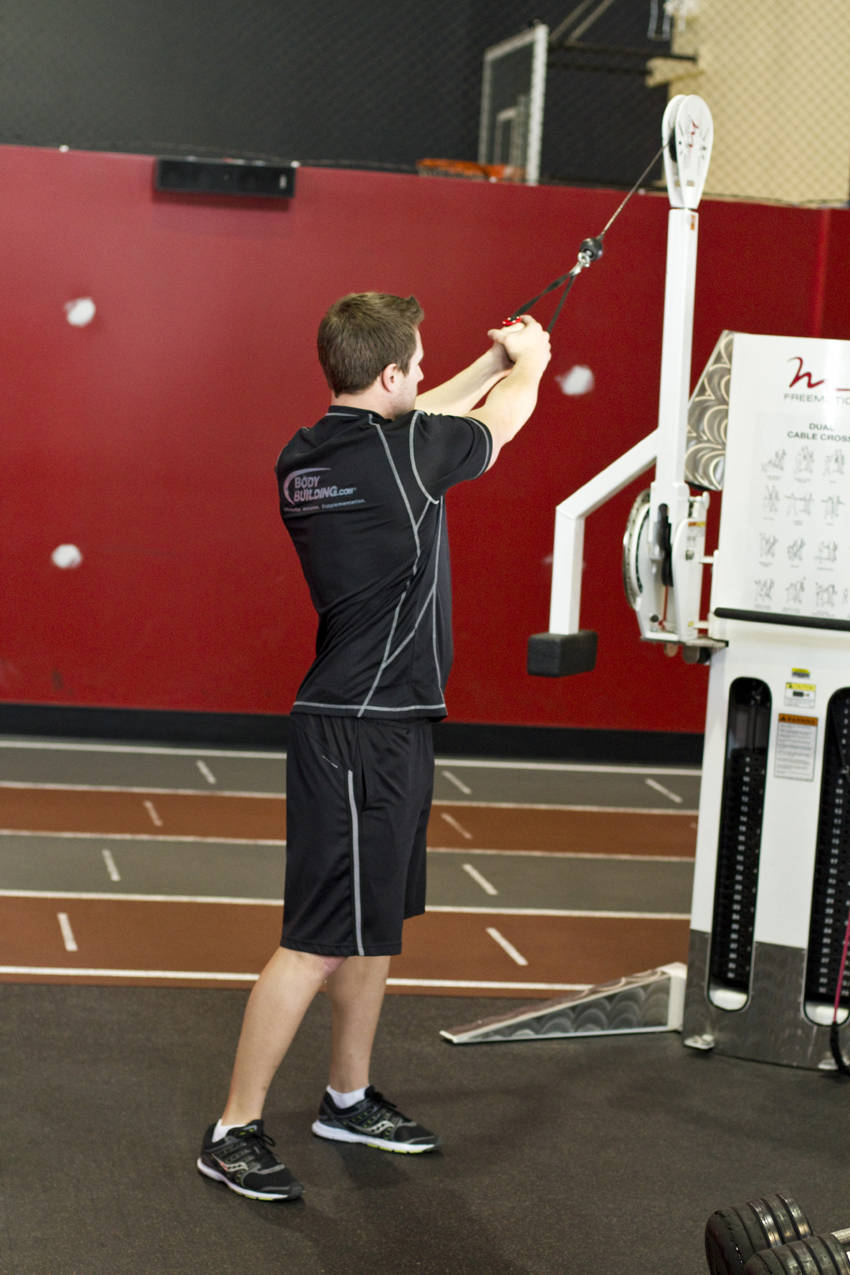
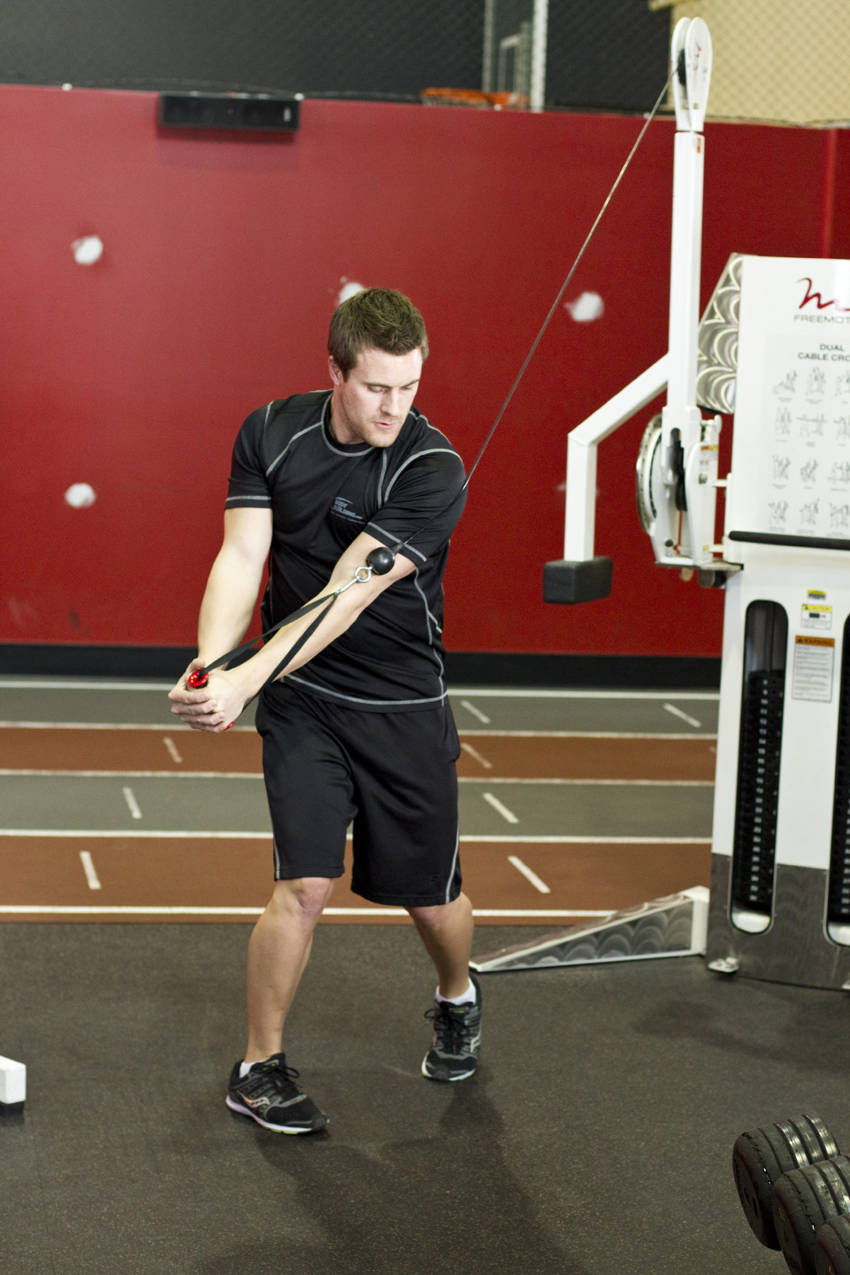
The Cable Woodchopper is one of the best moves for building functional rotational strength through your trunk. Unlike crunches that train the core in a straight line, the woodchopper challenges your obliques to both produce and resist rotation under constant cable tension. That diagonal chopping path mimics the athletic patterns behind a golf swing, a throw, or a hard change of direction, so the strength you build carries over to sport and everyday twisting. Set up at a high pulley, brace hard, and drive the movement from your torso rather than your arms. Done well, it sculpts the waistline while teaching your core to transfer force between hips and shoulders.
How to do the cable woodchopper
- Set the cable pulley to its highest position and attach a single handle or rope. Stand side-on to the machine with feet shoulder-width apart, far enough away that the cable stays taut at the start.
- Reach up and across with both hands to grip the handle. Your arms should be extended toward the high pulley on the side nearest the machine, with a slight bend in the elbows.
- Brace your core, set a soft bend in the knees, and keep your hips and feet pointing forward. This is your starting position.
- Initiate the movement by rotating through your trunk, pulling the handle down and diagonally across your body toward your opposite hip or knee.
- Let your torso turn as a unit and allow the back heel to pivot slightly, but keep your arms relatively straight so the obliques do the work rather than the biceps and shoulders.
- Finish with your hands outside the opposite hip, ribs stacked over the pelvis, feeling a strong contraction in the obliques on the working side.
- Resist the cable as you return slowly and under control to the top start position, keeping tension the whole way. Complete all reps, then switch sides.
Muscles worked
The primary muscle trained by the Cable Woodchopper is the obliques (internal and external), which drive trunk rotation and resist the cable's pull as you chop down and across. They are the engine that turns the torso and decelerates it at the bottom of each rep. The abs (rectus abdominis and the deep transverse abdominis) act as key secondary muscles, bracing the spine and stabilizing the pelvis so force transfers cleanly between hips and shoulders. Supporting roles come from the shoulders, lats, and glutes, which anchor the movement and help control the diagonal path, while the hips and feet provide a stable base to rotate against.
Benefits
- Builds rotational core strength that transfers directly to sports like golf, tennis, throwing, and combat athletics
- Trains the obliques through their full function of both creating and resisting rotation under constant tension
- Strengthens the anti-rotation and bracing capacity of the deep abs, supporting spinal stability
- Improves force transfer between your hips and shoulders for more powerful, coordinated athletic movement
- Cable resistance keeps the core loaded through the entire range, with no dead spot at the top or bottom
Common mistakes
- Using only the arms: Pull from your trunk by rotating the torso, not by bending the elbows and yanking with the biceps and shoulders.
- Letting the lower back round or overarch: Keep ribs stacked over your pelvis and brace so the spine stays neutral throughout the chop.
- Going too heavy: Excess load forces you to muscle the cable with the arms and breaks rotational form; pick a weight you can control for all reps.
- Locking the hips and over-twisting the spine: Allow the hips to rotate and the back heel to pivot so the motion comes from the trunk, not just the lumbar spine.
- Rushing the return: Resist the cable on the way back instead of letting it snap your arms up, keeping the obliques under tension the whole time.
- Standing too close to the stack: If the cable goes slack at the top you lose tension; step out far enough to keep it taut at the start.
Form tips
- Drive the movement by rotating through the trunk, keeping your arms long so the obliques lead every rep.
- Brace your core as if expecting a punch before you start the chop, and hold that tension throughout.
- Pivot the back foot and let the hips rotate with the torso so you turn as one connected unit.
- Move at a controlled, deliberate tempo rather than swinging the weight with momentum.
- Exhale forcefully as you chop down and across to deepen the oblique contraction at the finish.
Sets & reps
A solid default is 3 sets of 12 to 15 reps per side with about 60 seconds of rest, which is ideal for building oblique endurance and control. For hypertrophy and a stronger waistline, work in the 10 to 15 rep range per side with a moderate, controllable load for 3 to 4 sets. If your goal is rotational power for sport, drop to 6 to 10 crisp, fast-but-controlled reps per side using slightly heavier resistance, prioritizing speed of rotation over grinding. Always train both sides equally, and never sacrifice form to add weight, since the value of this move is in clean rotation, not heavy loading.
Frequently asked questions
What muscles does the Cable Woodchopper work?
The Cable Woodchopper primarily targets the obliques, the muscles on the sides of your trunk that drive and resist rotation. The abs, including the deep transverse abdominis, act as secondary stabilizers, while the shoulders, lats, and glutes help anchor and control the diagonal chopping path.
Is the Cable Woodchopper good for building a six-pack?
It mainly develops the obliques and overall core strength rather than isolating the rectus abdominis that forms the visible six-pack. It builds a strong, athletic midsection, but visible abs depend largely on lowering body fat through diet and overall training alongside core work like this.
High to low or low to high: which woodchopper is best?
The classic Cable Woodchopper goes high to low, chopping from a high pulley down across to the opposite hip, which emphasizes the obliques. A low-to-high reverse chop shifts emphasis slightly and trains a different angle. Both are valuable, so rotating between them gives the most complete core development.
How heavy should I go on the Cable Woodchopper?
Choose a weight light enough that you rotate from your trunk rather than yanking with your arms, and that lets you control the return for all 12 to 15 reps. If your lower back twists or your form breaks down, the load is too heavy. Quality rotation beats heavy weight here.
Is the Cable Woodchopper safe for your lower back?
Done correctly it strengthens the muscles that protect the spine. Keep your core braced, let your hips and back foot pivot so the rotation comes from the trunk rather than the lumbar spine, and avoid excessive load. If you have an existing back injury, start light and consult a professional.
Can I do woodchoppers without a cable machine?
Yes. You can replicate the pattern with a resistance band anchored high, a medicine ball for a dynamic chop and throw, or a single dumbbell or weight plate. The cable version is preferred because it keeps constant tension through the full range, but bands are an excellent home alternative.