The face pull is one of the best exercises for building the rear delts and bulletproofing your shoulders. Most lifters spend their training pushing — bench, overhead press, dips — which loads the front of the shoulder and pulls the upper body forward over time. The face pull is the counterweight. Using a cable and rope at roughly face height, you pull toward your forehead while driving the elbows high and externally rotating the shoulders. That combination hits the often-neglected rear delts, mid-traps and rotator cuff in one clean movement. It's beginner-friendly, easy on the joints, and one of the highest-value "prehab" lifts you can add to any program.
How to do the face pull
- Set a rope attachment on a cable pulley at face height or slightly above, and select a light weight to start — this is a high-rep, control-focused movement.
- Grab the rope with a neutral grip (thumbs pointing back toward you), take a step back, and hold your arms out straight with a slight lean back so the cable is taut and your shoulders are stretched forward.
- Brace your core, keep your chest tall, and initiate the pull by driving your elbows up and out to the sides — think about leading with the elbows, not the hands.
- Pull the rope toward your forehead or the bridge of your nose, separating your hands as you go so the ends of the rope finish beside your ears.
- At the end range, externally rotate so your knuckles point toward the ceiling and squeeze your rear delts and shoulder blades together hard.
- Pause for a beat at full contraction, keeping your elbows high and level with or above your shoulders.
- Return slowly under control to the fully stretched starting position, resisting the cable the whole way rather than letting it snap your arms forward.
Muscles worked
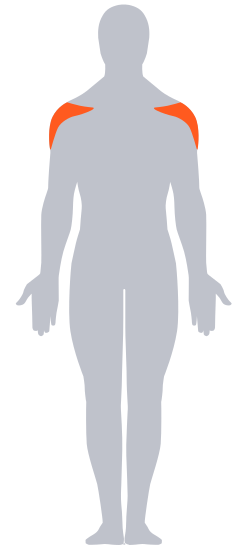
The primary muscle worked is the rear delts (posterior deltoids), which sit on the back of the shoulder and drive horizontal abduction — pulling the upper arms back and out to the sides as you flare your elbows. The traps, specifically the middle and lower trapezius, act as key secondary movers by retracting and stabilizing the shoulder blades at the contraction. The rotators (the rotator cuff, mainly infraspinatus and teres minor) handle the external rotation phase when you turn your knuckles toward the ceiling, which is exactly what makes the face pull so valuable for shoulder health and joint stability.
Benefits
- Directly targets the rear delts, a commonly underdeveloped muscle that rounds out the shoulders and balances heavy pressing volume.
- Strengthens the rotator cuff and external rotators, improving shoulder stability and reducing injury risk on the bench and overhead press.
- Improves posture by reinforcing scapular retraction and counteracting the forward-rounded shoulders from desk work and pushing exercises.
- Joint-friendly and beginner-accessible — the cable provides constant, smooth tension with no jarring loading at end range.
- Builds the mid and lower traps for a thicker, more controlled upper back and better scapular positioning under load.
Common mistakes
- Pulling too low (toward the chest or chin): keep the rope path aimed at your forehead so the elbows stay high and the rear delts do the work.
- Going too heavy and yanking with the back: drop the weight, slow down, and let the rear delts move the load instead of the lats and momentum.
- Letting the elbows drop below shoulder height: cue your elbows up and out so the line of pull stays on the rear delts, not the lats.
- Skipping the external rotation: rotate your knuckles toward the ceiling at the finish — without it you lose the rotator cuff benefit.
- Rushing the eccentric: control the return instead of letting the cable snap your arms forward, since the stretched position is where much of the work happens.
- Shrugging up into the upper traps: keep your shoulders down and back so the mid-traps and rear delts stay engaged.
Form tips
- Set the pulley at face height or just above and use a rope so your hands can separate freely at the finish.
- Lead with your elbows, keeping them high and pointed out to the sides throughout the pull.
- Pause and squeeze for a full beat at peak contraction to maximize rear delt and trap engagement.
- Add deliberate external rotation at the end range — knuckles to the ceiling — to recruit the rotator cuff.
- Stay light and prioritize a smooth, controlled rep over heavier loads that force you to cheat.
Sets & reps
Because the rear delts and rotator cuff respond best to controlled, higher-volume work, the face pull is programmed lighter than most pulls. A solid default is 3 sets of 15 to 20 reps with about 60 seconds of rest. For general shoulder health and hypertrophy, stay in the 12 to 20 rep range and chase a strong squeeze rather than heavy load. For endurance or as a posture-focused finisher, push toward 20 to 25 reps. Train face pulls 2 to 3 times per week — they recover quickly and pair well at the end of any push or pull session.
Frequently asked questions
What muscles does the face pull work?
The face pull primarily targets the rear delts (posterior deltoids) on the back of the shoulder. It also strongly works the middle and lower traps through scapular retraction and the rotator cuff muscles through the external rotation at the end of each rep, making it a complete shoulder-health movement.
Why are face pulls so good for shoulder health and posture?
Face pulls strengthen the rear delts, mid-traps and rotator cuff — the exact muscles that pull your shoulders back and stabilize the joint. Since most training emphasizes pushing, this balances the shoulder, counteracts forward-rounded posture, and improves stability on presses, reducing injury risk.
How much weight should I use for face pulls?
Use a light to moderate weight that lets you complete 15 to 20 clean reps with full external rotation and a controlled return. If you're swinging, leaning back hard, or recruiting your lats and lower back, the load is too heavy. Form and the squeeze matter far more than the number on the stack.
Where should I pull the rope to on a face pull?
Aim the rope toward your forehead or the bridge of your nose, finishing with the rope ends beside your ears and your elbows high. Pulling too low toward your chest or chin shifts the work to your lats and removes the rear delt and rotator cuff benefit the exercise is designed for.
How often should I do face pulls?
Face pulls recover quickly and can be trained 2 to 3 times per week. They work well as a finisher on push or pull days, or as part of a warm-up to prime the shoulders. For 3 sets of 15 to 20 reps, that frequency is plenty to improve posture and rear delt development.
Are face pulls good for beginners?
Yes. The face pull is beginner-friendly because the cable provides smooth, constant tension and the light loads are easy on the joints. The main skill to learn is leading with high elbows and adding external rotation at the finish, both of which come quickly with practice and a mirror check.