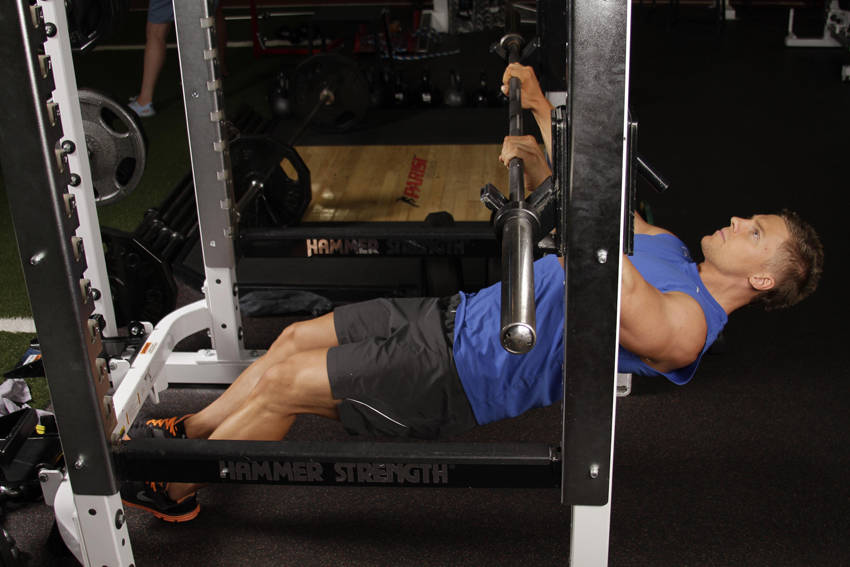
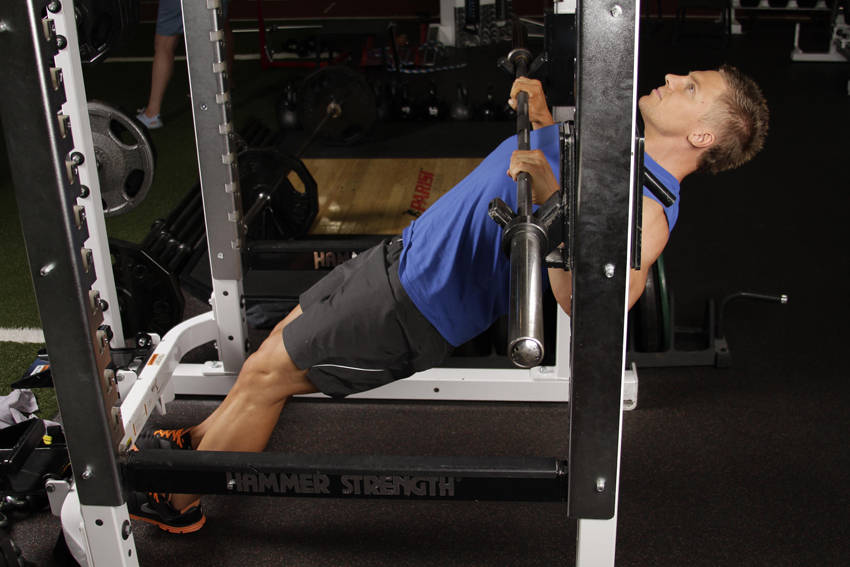
The inverted row is one of the best horizontal pulling exercises for building a strong, healthy upper back without any weights. Sometimes called the bodyweight row or Australian pull-up, it has you lie under a fixed bar, grab it, and pull your chest up while your heels stay on the floor. Because you control the angle of your body, it scales from near-vertical (easy) to fully horizontal (hard), making it ideal for beginners who can't yet do a pull-up. It directly trains the scapular retractors and lats that posture and pressing balance depend on, and it builds the pulling base every lifter needs.
How to do the inverted row
- Set a bar at roughly hip-to-waist height in a rack or Smith machine, or use a TRX or sturdy table edge. Lie underneath it.
- Reach up and grip the bar slightly wider than shoulder-width with an overhand grip, arms fully extended.
- Set your body in a rigid plank: squeeze your glutes, brace your core, and keep a straight line from your heels through your hips to your shoulders.
- Initiate the pull by retracting your shoulder blades first, then drive your elbows down and back to bring your chest toward the bar.
- Pull until your chest touches or nears the bar and your shoulder blades are fully squeezed together at the top.
- Pause briefly, then lower yourself with control over 2-3 seconds until your arms are fully straight again.
- Reset your scapular position and repeat for the target reps, keeping your hips up the entire set.
Muscles worked
The inverted row's primary mover is the upper back — specifically the mid and lower trapezius and the rhomboids, which retract and stabilize the shoulder blades, along with the latissimus dorsi and posterior deltoids that drive the elbows down and back. The biceps act as the main secondary muscle, flexing the elbow to bring your chest to the bar. The forearms and grip work isometrically to hold the bar, while the core, glutes, and hamstrings fire hard to keep your body in a rigid plank. This combination makes the inverted row a true upper-back builder that also reinforces full-body tension and anti-extension core strength.
Benefits
- Builds upper-back strength and scapular control that improves posture and balances out pressing work like push-ups and bench press
- Infinitely scalable for any level: raise the bar for an easier angle, lower it toward horizontal to make it harder
- Requires only a bar or suspension trainer, making it a perfect home and travel pulling exercise
- Strengthens the foundational pulling pattern that carries over to pull-ups and chin-ups
- Joint-friendly on the shoulders and lower back since you support your own bodyweight in a stable plank position
Common mistakes
- Sagging the hips: keep your glutes and core braced so your body stays in one straight line instead of letting your butt drop toward the floor.
- Leading with the chin or head: drive your chest to the bar, not your face, so the upper back does the work rather than your neck.
- Shrugging the shoulders up toward your ears: depress and retract the shoulder blades first to keep tension in the traps and rhomboids.
- Using a half rep range: pull until your chest reaches the bar and lower until your arms are fully straight to train the full stretch and contraction.
- Pulling too fast and dropping down: control the lowering phase for 2-3 seconds to get the most upper-back and bicep stimulus.
- Picking too hard an angle: if your form breaks, raise the bar higher so your torso is more upright and the movement is easier.
Form tips
- Squeeze your glutes hard before the first rep to lock your hips up and keep the plank line intact.
- Think 'elbows to the back pockets' to drive the pull from your upper back rather than your arms.
- Pause for a one-second squeeze at the top of each rep to maximize shoulder-blade retraction.
- Adjust difficulty by walking your feet out (harder) or in (easier), or by elevating your feet for a more advanced variation.
- Keep your wrists stacked over the bar and your gaze neutral, looking up rather than craning your neck forward.
Sets & reps
Start with 3 sets of 8-15 reps and about 60 seconds of rest, as in the seed program. For strength, lower the bar to a harder horizontal angle and aim for 4-6 controlled reps with longer rest near 90 seconds. For hypertrophy, the 8-15 rep range with a one-second squeeze at the top is ideal; add reps or lower the bar as you progress. For muscular endurance, use a slightly easier angle and perform 15-20 reps. Once bodyweight reps feel easy, progress by lowering your body toward horizontal, elevating your feet, or adding a weight vest.
Frequently asked questions
Is the inverted row good for beginners?
Yes. The inverted row is one of the best pulling exercises for beginners because you control the difficulty by changing your body angle. Keeping the bar higher and your torso upright makes it easy, and lowering toward horizontal makes it harder, so it scales to any level.
What muscles does the inverted row work?
The inverted row primarily works the upper back, including the trapezius, rhomboids, lats, and rear delts that retract the shoulder blades and pull the elbows back. The biceps are the main secondary muscle, and the core, glutes, and grip work to hold your body in a rigid plank.
Is the inverted row a good substitute for pull-ups?
It is an excellent complement and a stepping stone to pull-ups. The inverted row is a horizontal pull that builds the same upper-back and bicep strength while being easier to scale, making it ideal if you can't yet do a pull-up or want to balance vertical pulling.
How do I make the inverted row harder?
Lower the bar so your body is closer to horizontal, walk your feet farther out, or elevate your feet on a bench. You can also slow the lowering phase, add a pause at the top, wear a weight vest, or switch to a single-arm or feet-elevated variation.
Why do my hips keep sagging during inverted rows?
Sagging hips usually mean your core and glutes aren't braced. Squeeze your glutes and brace your abs before the first rep to lock your body into one straight line. If you still can't hold the plank, raise the bar to an easier angle until your strength improves.
How often should I do inverted rows?
Two to three times per week works well for most lifters. Treat the inverted row as a primary horizontal pull in your upper-body or full-body sessions, leaving at least a day between hard sets so your upper back and biceps recover.