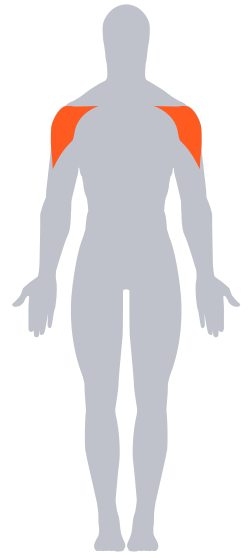
The dumbbell lateral raise is the single most effective isolation exercise for building the side delts, the muscle that gives your shoulders their rounded, capped width and the coveted V-taper. Because pressing movements lean heavily on the front delts, most lifters need dedicated side-delt work to balance the shoulder out, and the lateral raise delivers exactly that. It is beginner-friendly, requires only a pair of dumbbells, and teaches you to feel a specific muscle working. Done right, it is also one of the most-butchered lifts in the gym: ego loading turns it into a momentum-driven shrug. Master light, strict reps and you will see real results.
How to do the lateral raise
- Stand tall with a dumbbell in each hand, arms hanging at your sides, palms facing your thighs. Set your feet about hip-width apart and brace your core.
- Soften your elbows into a fixed, slight bend (around 10 to 20 degrees) and keep that angle locked for the entire set; the arm should not straighten or curl as you move.
- Leading with your elbows rather than your hands, raise both dumbbells out to the sides in a wide arc until your upper arms reach roughly shoulder height.
- Keep your wrists neutral and the pinky side of your hand level with or slightly above the thumb, as if pouring out a small jug of water, to bias the side delt.
- Pause briefly at the top with your arms just below or at shoulder level; do not throw them higher, which shifts the load onto the traps.
- Lower the dumbbells slowly and under control back to your sides, resisting gravity the whole way down rather than letting them drop.
- Keep your torso upright and still throughout; if your body sways to heave the weight up, the dumbbells are too heavy.
Muscles worked
The primary muscle worked is the side delts (lateral deltoid), the middle head of the shoulder that abducts the arm, lifting it out and away from the body. This is the muscle responsible for shoulder width, and the lateral raise targets it more directly than almost any other movement. The secondary muscle is the traps (upper trapezius), which assist by upwardly rotating and stabilizing the shoulder blade, especially in the top portion of the range. The supraspinatus of the rotator cuff initiates the first few degrees of the raise, and the forearms work isometrically to grip. The goal is to maximize side-delt tension while keeping trap involvement to a supporting role, not letting them take over via shrugging.
Benefits
- Directly builds the side delts for broader, more capped shoulders and a stronger V-taper.
- Balances out press-dominant programs that overdevelop the front delts and neglect the sides.
- Improves shoulder stability and healthy overhead function by strengthening the lateral head.
- Requires only a pair of dumbbells, making it easy to do at home or in any gym.
- Teaches the mind-muscle connection and strict control that carry over to all isolation work.
Common mistakes
- Using momentum and swinging: cut the weight and initiate each rep from a dead stop with no hip or torso heave.
- Shrugging the traps up: keep your shoulders down and away from your ears, and stop the raise at shoulder height instead of driving higher.
- Going too heavy: lateral raises are a high-rep, low-load exercise; if you cannot pause at the top, the dumbbells are too heavy.
- Leading with the hands: think about lifting your elbows, not your wrists, so the side delt does the work instead of the front delt.
- Raising the arms in front of the body: keep the dumbbells in line with or slightly behind your torso so the lateral head is loaded, not the front delt.
- Letting the weight drop on the way down: control the lowering phase, since the eccentric is where much of the muscle-building tension lives.
Form tips
- Lead with the elbows, not the hands, to keep tension on the side delt rather than shifting it to the front delt.
- Lighter weight with perfect form beats heavy swinging every time; this is an exercise where ego loading kills results.
- Use a slight forward lean or set up on an incline bench to keep tension on the side delt through a longer range of motion.
- Pour the jug: tilt the pinky slightly up at the top to better isolate the lateral head.
- Keep a slow, controlled tempo and pause at the top to eliminate momentum and maximize the contraction.
Sets & reps
The lateral raise responds best to moderate-to-high reps because the side delt is a small muscle that thrives on volume and time under tension rather than heavy load. A reliable default is 3 sets of 12 to 20 reps with 60 seconds of rest. For hypertrophy, the main goal of this lift, work in the 12 to 20 rep range and chase a deep burn, optionally finishing with a drop set or partial reps. For muscular endurance, push 20 to 25 reps. Pure strength work is not the point here; instead, focus on progressive overload by adding small increments or reps over time. Train side delts two to three times per week, as they recover quickly.
Frequently asked questions
What muscles does the dumbbell lateral raise work?
The lateral raise primarily targets the side delts (lateral deltoid), the muscle that creates shoulder width. The upper traps assist as a secondary muscle by stabilizing and rotating the shoulder blade, and the supraspinatus helps initiate the movement. It is one of the most direct side-delt isolation exercises you can do.
How much weight should I use for lateral raises?
Far less than you think. The side delt is small and the lateral raise has a long lever arm, so most lifters do best with light dumbbells they can control for 12 to 20 strict reps. If you have to swing, lean, or shrug to lift the weight up, it is too heavy. Prioritize clean form over the number on the dumbbell.
Why can't I feel my side delts during lateral raises?
Usually it is because you are leading with your hands and the front delts or traps are taking over. Lighten the load, lead with your elbows, keep your shoulders down away from your ears, and slow the tempo. A slight forward lean and pausing at the top also help shift tension squarely onto the lateral delt.
How high should I raise the dumbbells?
Raise until your upper arms reach roughly shoulder height, so the dumbbells are about level with your shoulders. Going higher recruits the traps and turns the move into a shrug. Stopping at or just below shoulder level keeps the tension on the side delts where you want it.
Are lateral raises good for beginners?
Yes. The lateral raise is a beginner-friendly isolation exercise that needs only dumbbells and teaches the mind-muscle connection. Because the load is light and the movement is simple, it is a safe way to start building shoulder width. Focus on strict form from day one to avoid building the bad habit of swinging.
How often should I train lateral raises?
The side delts are a small muscle that recovers quickly, so you can train lateral raises two to three times per week. Spreading your volume across multiple sessions, with around 3 sets each, often drives better growth than cramming everything into one shoulder day. Adjust based on your overall shoulder and pressing volume.