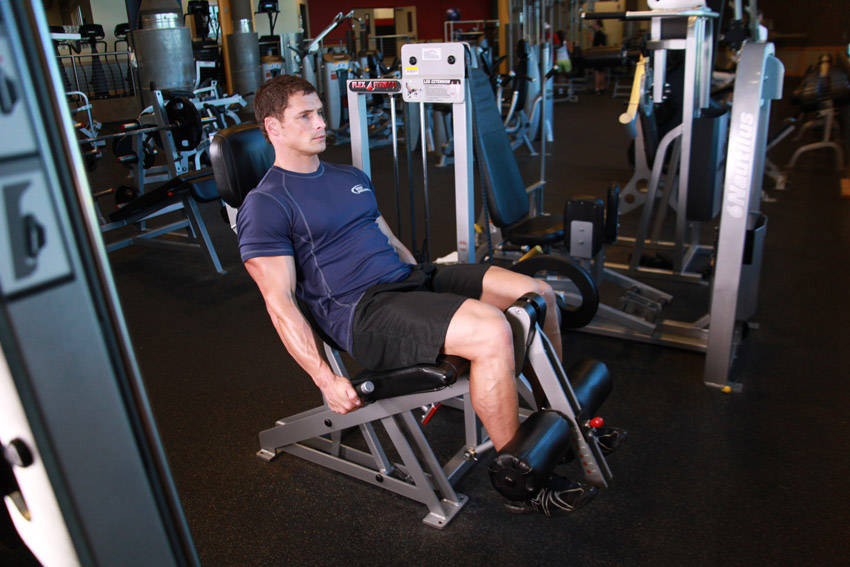

The leg extension is a seated machine exercise that isolates the quadriceps better than almost any other movement. Because the machine fixes your hips and back, the only joint working is the knee — so every rep drives load straight into your quads with no help from the glutes, hamstrings, or spinal erectors. That makes it a favorite for adding knee-extension strength, building teardrop (vastus medialis) detail, and pre-fatiguing the quads before squats. It's beginner-friendly: the path is fixed, balance isn't a factor, and you can dial the weight in one pin. Used with control, it's also a staple in knee rehab and accessory work.
How to do the leg extension
- Adjust the seat so the back pad supports you with your knees lined up exactly with the machine's rotating axis (the pivot point of the lever arm) — this protects the knee and loads the quads correctly.
- Set the shin pad so it rests low on your shins, just above the ankle joint, not pressing into the front of your foot or up against your calf.
- Sit tall against the back pad, grip the handles at your sides, and brace your core so your torso stays still throughout the set.
- Extend your knees and lift the pad upward until your legs are nearly straight — drive the toes slightly up to bias the quads, but stop just short of locking out hard.
- Pause and squeeze the quads for a beat at the top, keeping tension on the muscle rather than resting on the joint.
- Lower the weight slowly and under control back to the start, resisting the pad on the way down instead of letting it drop.
- Keep your hips and lower back planted on the seat the entire time — no bouncing, no lifting off the pad.
Muscles worked
The leg extension's primary mover is the quadriceps — the four-headed muscle group on the front of your thigh: the rectus femoris, vastus lateralis, vastus medialis (the teardrop just above the inner knee), and vastus intermedius. Knee extension is the quads' single job, and because the leg extension isolates exactly that movement, it loads all four heads with no help from surrounding muscles. Pointing the toes slightly toward you can shift emphasis subtly, but all heads work on every rep. Unlike squats or leg presses, there's no hip, glute, hamstring, or lower-back involvement — which is precisely why this machine is the go-to for targeting the quads directly and for isolating them in rehab settings.
Benefits
- Isolates the quadriceps more directly than any compound leg movement, with zero load on the lower back.
- Beginner-friendly and stable — the fixed path means no balance or technique barrier to start training the quads.
- Builds the vastus medialis (teardrop) and overall quad detail that squats alone can under-develop.
- Great pre-exhaust or finisher: tire the quads before squats, or burn them out at the end of leg day.
- Commonly used in knee rehab and prehab because the load and range are easy to control precisely.
Common mistakes
- Swinging the weight up with momentum: lower the load and use a slow, controlled tempo so the quads — not a hip thrust — move the pad.
- Letting the weight crash on the way down: resist the eccentric, taking 2-3 seconds to lower for far more muscle tension.
- Pad sitting too high on the shin or against the foot: position it low, just above the ankle, so the lever arm and your leverage are correct.
- Knee not aligned with the machine's pivot: line up the rotating axis with your knee joint to avoid shearing stress on the knee.
- Hips lifting off the seat at the top: stay planted and braced; if you have to come up, the weight is too heavy.
- Hyperextending or slamming into lockout: stop just short of a hard lock to keep tension on the muscle and off the joint.
Form tips
- Squeeze and hold the contraction for a count at the top — the peak of the rep is where the quads work hardest.
- Set the seat back so your knee lines up with the machine's pivot point before you ever touch the weight.
- Keep the rep slow in both directions; this is an isolation move, so control beats heavy weight every time.
- Point your toes slightly toward your shins to keep tension biased on the quads through the full range.
- If your knees ache, reduce the range slightly and avoid a hard lockout rather than pushing through pain.
Sets & reps
For most lifters, 3 sets of 12-15 reps with about 60 seconds of rest is the sweet spot — enough volume to fatigue the quads without straining the knee. For hypertrophy (building size), 3-4 sets of 10-15 reps taken close to failure works best, and the leg extension responds well to higher reps and slower tempos. For muscular endurance or rehab, lean toward 15-20 reps with lighter load. Because this is an isolation move, avoid grinding heavy low-rep sets — the knee joint doesn't love near-maximal extension loads. Place it after your big compound lifts, or use it as a pre-exhaust before squats.
Frequently asked questions
What muscle does the leg extension work?
The leg extension targets the quadriceps — the four muscles on the front of the thigh (rectus femoris, vastus lateralis, vastus medialis, and vastus intermedius). Because the machine isolates knee extension, it loads the quads directly with no involvement from the glutes, hamstrings, or lower back.
Is the leg extension bad for your knees?
For most healthy lifters, the leg extension is safe when done with moderate weight, controlled tempo, and proper knee alignment with the machine's pivot. It does place shearing force on the knee at full extension, so avoid slamming into lockout and ego-lifting. If you have a knee injury, check with a professional and keep loads light.
Are leg extensions enough to build quads?
Leg extensions build the quads effectively but work best as an accessory, not a replacement for compounds. Pair them with squats, leg presses, or lunges, which add overall mass and strength. Use leg extensions to isolate the quads, target the teardrop, and add volume your compounds miss.
How heavy should I go on leg extensions?
Use a weight you can control for 12-15 clean reps without swinging or lifting your hips off the seat. Since this is an isolation exercise, lighter and stricter beats heavy and sloppy. If your hips come up or you need momentum to start the rep, drop the weight.
Should I point my toes during leg extensions?
Pulling your toes slightly toward your shins (dorsiflexion) keeps tension biased on the quads and is the standard cue. Pointing toes away can shift slight emphasis but is less common. The bigger priority is a controlled tempo and a squeeze at the top, which matter far more than foot angle.
Where do leg extensions fit in a leg workout?
Place leg extensions after your main compound lifts as an accessory, or use them as a pre-exhaust before squats to fatigue the quads first. They're also a strong finisher for higher-rep burnout sets. As a beginner machine move, they're easy to slot in anywhere on leg day.