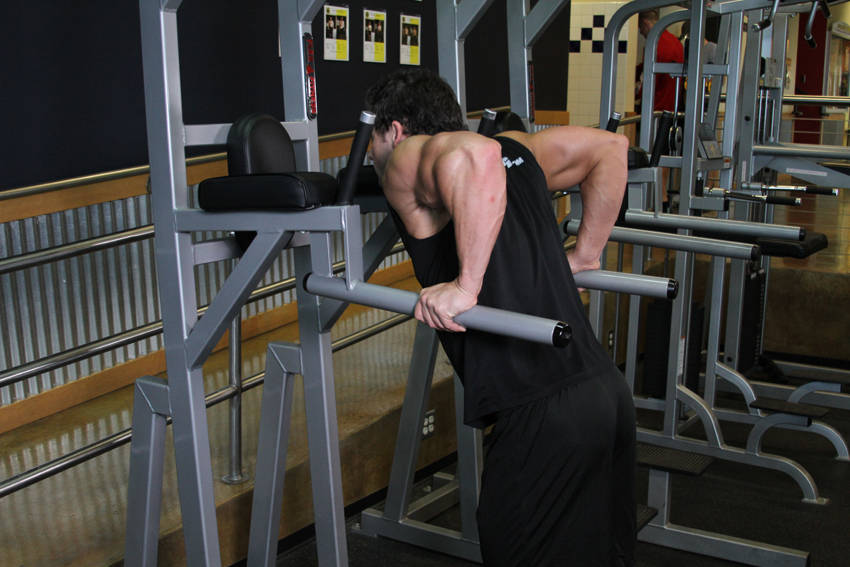
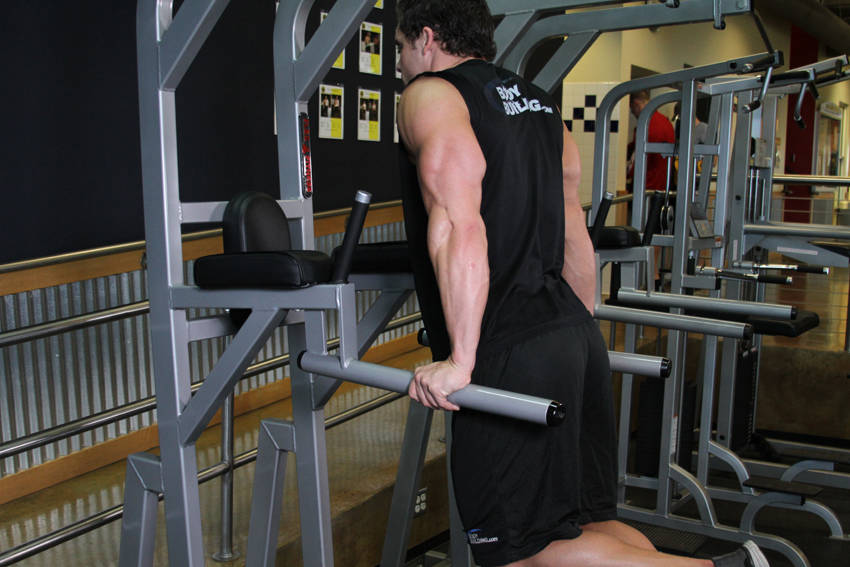
The triceps dip is one of the most effective bodyweight builders for arm strength and lockout power. Performed on parallel bars, it forces your triceps to move your entire bodyweight through a deep elbow range, which is hard to match with isolation work. By keeping your torso upright, you shift the emphasis off the chest and onto the triceps, making the dip a near-perfect mass and strength exercise for the back of the arms. It also strengthens the front delts and chest as supporting movers. Because it loads the shoulders in a stretched position, the dip rewards good technique and patient progression, but once you own it, few moves carry over better to bench press lockout and overhead pressing.
How to do the triceps dip
- Grip two parallel bars roughly shoulder-width apart and press up to a fully locked-out starting position with your arms straight, shoulders down, and chest tall.
- Set your torso as vertical as possible and tuck your chin slightly; a more upright trunk keeps tension on the triceps rather than the chest.
- Brace your core, point your toes down, and cross or bend your legs slightly so your body hangs in a stable, controlled hollow position.
- Lower yourself slowly by bending the elbows, keeping them tracking back and close to your sides rather than flaring out to the sides.
- Descend until your elbows reach roughly 90 degrees and your upper arms are about parallel to the floor; stop here if your shoulders feel pinched.
- Drive through your palms and press back up powerfully, extending the elbows until your arms are fully locked out at the top.
- Squeeze the triceps hard at lockout, reset your shoulder position, and repeat for the prescribed reps without bouncing out of the bottom.
Muscles worked
The primary muscle worked in the triceps dip is the triceps, the three-headed muscle on the back of the upper arm responsible for straightening the elbow. As you press out of the bottom and lock the arm, all three heads, especially the long and medial heads, work hard to extend the elbow under your full bodyweight. The chest, particularly the lower pec fibers, acts as a key secondary mover and contributes more as you lean the torso forward. The front delts (anterior deltoids) assist by stabilizing and driving the shoulder through the press. Smaller stabilizers, including the scapular muscles, rotator cuff, and core, keep your torso steady and your shoulders safe throughout each rep.
Benefits
- Builds serious triceps mass and strength using only bodyweight, making it ideal for home or minimal-equipment training.
- Improves bench press and overhead press lockout strength by training the same elbow-extension pattern under heavy load.
- Strengthens the chest and front delts as supporting movers, giving you well-rounded pushing power.
- Easily scaled and overloaded: add a dip belt and weight for progression or use a band or assisted machine to regress.
- Trains shoulder and scapular stability through a deep, challenging range that carries over to other pressing lifts.
Common mistakes
- Going too deep with cranky shoulders: stop at roughly 90 degrees of elbow bend rather than sinking until the shoulders ache or pinch.
- Flaring the elbows wide: keep them tracking back and tucked toward your sides to protect the shoulders and load the triceps.
- Leaning the torso forward when chasing triceps: stay upright to bias the triceps; save the forward lean for chest-focused dips.
- Bouncing out of the bottom: control the descent and press without using momentum or a hard rebound at the bottom.
- Shrugging the shoulders up to the ears: keep the shoulders pulled down and away from the ears to maintain a stable, safe joint position.
- Cutting the rep short at the top: lock the elbows fully and squeeze the triceps to train the full range and lockout strength.
Form tips
- Stay as upright as possible to maximize triceps tension; only lean forward when you intentionally want to target the chest.
- Keep your elbows tucked and tracking straight back, not flaring out, so the load stays on the triceps and off the shoulders.
- Control the lowering phase, aiming for a steady two-to-three-second descent rather than dropping into the bottom.
- Press all the way to a full elbow lockout on every rep and pause briefly to own the top position.
- Once you can do clean reps for the top of your range, add load with a dip belt instead of just adding more reps.
Sets & reps
Most lifters do well with 3 sets of 8 to 15 reps with about 90 seconds of rest, the seed recommendation, and it suits hypertrophy nicely. For pure strength, add a dip belt and work in the 4 to 6 rep range for 3 to 5 sets with longer rests of 2 to 3 minutes. For muscle growth, stay in the 8 to 12 rep range and train close to failure, leaving 1 to 2 reps in reserve. For endurance or beginners building capacity, aim for 12 to 20 controlled reps. If you cannot yet hit the bottom of any range with good form, use band assistance or an assisted dip machine and progress over time.
Frequently asked questions
Do triceps dips work the triceps or the chest more?
It depends on your torso angle. Staying upright with elbows tucked biases the load toward the triceps, which is the primary muscle in this version. Leaning your torso forward and letting the elbows flare shifts more emphasis onto the chest, especially the lower pecs. For triceps-focused dips, keep your trunk as vertical as possible.
How deep should I go on a triceps dip?
Lower until your elbows reach roughly 90 degrees, with your upper arms about parallel to the floor. Going deeper increases the stretch on the shoulders, which can aggravate cranky or injury-prone shoulders. If you feel pinching or discomfort before 90 degrees, stop short and work within a pain-free range.
Are triceps dips an intermediate exercise?
Yes. The triceps dip is rated intermediate because it requires you to control your full bodyweight through a deep range while stabilizing the shoulders. Beginners often start with band-assisted dips or an assisted dip machine to build strength and confidence before progressing to full unassisted reps on parallel bars.
How do I make triceps dips harder once they get easy?
Add external load with a dip belt and weight plates, which lets you keep progressing in the same 8 to 15 rep range or drop into lower strength rep ranges. You can also slow the tempo, add pauses at the bottom, or increase total sets. Adding weight is the most direct way to keep building triceps mass.
Why do my shoulders hurt during triceps dips?
Shoulder pain usually comes from going too deep, flaring the elbows wide, or shrugging the shoulders up toward the ears. Limit depth to about 90 degrees, keep your elbows tucked and tracking back, and pull your shoulders down and away from your ears. If pain persists, reduce range or switch to a triceps exercise that loads the shoulder less.
Can I build big triceps with dips alone?
Triceps dips are an excellent mass builder because they load all three triceps heads under your full bodyweight, but pairing them with an overhead extension movement helps fully develop the long head. Progressively adding weight with a dip belt and training close to failure will drive most of the growth you want from this lift.