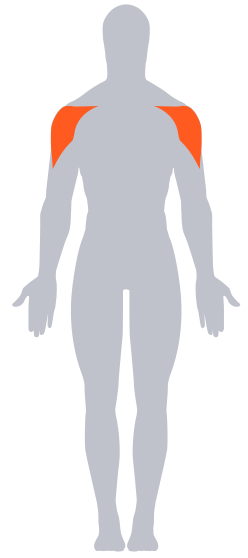
The Machine Shoulder Press is one of the safest ways to start building overhead pressing strength. Because the machine fixes the bar path and supports your back, you don't have to balance free weight or stabilize a barbell, so you can focus entirely on driving the handles overhead and feeling your shoulders work. That makes it ideal for beginners, for high-rep pump work, and for training shoulders when you're fatigued or recovering. It primarily develops the front delts, with the triceps helping you lock out each rep. Set the seat correctly and it becomes a reliable, joint-friendly delt builder.
How to do the machine shoulder press
- Adjust the seat height so the handles sit roughly at shoulder or upper-chest level when you're seated upright, and select your weight on the stack or load the plates.
- Sit tall with your back flat against the pad, feet planted firmly, and brace your core so your torso stays still throughout the set.
- Grip the handles with a full grip, wrists stacked over your forearms and elbows pointing down and slightly forward rather than flaring straight out to the sides.
- Exhale and press both handles smoothly overhead until your arms are nearly straight, stopping just short of locking the elbows hard.
- Pause briefly at the top with the handles roughly over your shoulders, keeping your shoulders down away from your ears.
- Lower the handles under control back to shoulder level, resisting the weight the whole way down rather than letting it drop.
- Reset your brace and repeat for the prescribed reps, keeping every rep through a full range of motion.
Muscles worked
The primary mover in the Machine Shoulder Press is the front delts (anterior deltoid), the front head of the shoulder that drives your arms up and forward into the overhead position. They do the bulk of the work pressing the handles from shoulder level to lockout. The triceps are the main secondary muscle, taking over near the top of each rep to straighten the elbows and complete lockout. The medial (side) deltoid and upper traps assist with stabilization and elevation, while your core and lats work isometrically to keep your torso pinned to the pad. The fixed path means stabilizer demand is low, so the targeted delts and triceps receive most of the tension.
Benefits
- Beginner-friendly: the guided bar path removes balance and stabilization demands so you can learn to press safely
- Directly builds the front delts for rounder, stronger-looking shoulders and a more capable overhead press
- Back support and a fixed path reduce strain on the lower back and shoulders compared with standing presses
- Easy to load and adjust, making it ideal for high-rep hypertrophy work and quick drop sets
- Great for safely training to or near failure since there's no barbell to control or rack
Common mistakes
- Partial reps: lower the handles to shoulder level and press to near-full extension every rep instead of cutting the range short.
- Wrong seat height: if the handles start too high or too low it strains the shoulders, so set them to shoulder level before loading.
- Flaring elbows straight out to the sides: keep them slightly forward to protect the shoulder joint and keep tension on the delts.
- Lifting off the back pad: brace your core and keep your spine against the pad rather than arching to muscle the weight up.
- Slamming the stack down: control the lowering phase instead of letting gravity drop the handles, which wastes the most productive part of the rep.
- Going too heavy: loading more than you can press cleanly forces partials and momentum, so pick a weight you control through full range.
Form tips
- Set the handles to start at shoulder or upper-chest level so you press through a full, joint-friendly range.
- Keep your shoulder blades down and slightly back to anchor the joint and avoid shrugging into your neck.
- Drive through the heels of your palms and think about pushing the handles slightly toward each other at the top.
- Stop just short of hard elbow lockout to keep continuous tension on the delts and protect the joints.
- Press and lower at a steady tempo, taking about two seconds to lower each rep for maximum muscle tension.
Sets & reps
For most lifters, 3 sets of 10–15 reps with about 75 seconds of rest is a great default and matches the machine's strengths for shoulder development. For hypertrophy (size), stay in the 8–15 rep range with moderate weight, chasing a strong burn in the delts and taking the last set close to failure. For muscular endurance and pump work, push toward 15–20 reps. Because the machine is so stable, it's a safe place to train near failure or add a drop set on your final set. Beginners should start lighter, nail full range of motion, and add weight only once form stays clean.
Frequently asked questions
What muscles does the Machine Shoulder Press work?
It primarily targets the front delts (anterior deltoid), the front of your shoulder that presses the handles overhead. The triceps are the main secondary muscle, finishing each rep by extending the elbows. The side delts, upper traps, and core assist with stabilization along the machine's fixed path.
Is the Machine Shoulder Press good for beginners?
Yes. It's a beginner-friendly push because the machine fixes the bar path and supports your back, so you don't have to balance free weight. That lets you focus on pressing technique and feeling your shoulders work, making it one of the safest ways to start building overhead strength.
How is the machine version different from a dumbbell or barbell shoulder press?
The machine guides the handles along a fixed path and supports your spine, so it demands far less stabilization than free-weight presses. That makes it safer and easier to learn, though dumbbell and barbell presses recruit more stabilizers and allow a more natural range of motion.
How many sets and reps should I do on the Machine Shoulder Press?
A solid default is 3 sets of 10–15 reps with about 75 seconds of rest. For size, stay in the 8–15 range and push the last set near failure; for endurance, aim for 15–20 reps. Always use a weight you can press through a full range.
Why do my shoulders hurt during the Machine Shoulder Press?
Discomfort usually comes from a poorly set seat, elbows flaring straight out to the sides, or pressing too heavy. Set the handles to shoulder level, keep elbows slightly forward, and lighten the load. If pain persists despite good form, stop and consult a professional.
How do I set up the seat on a shoulder press machine?
Adjust the seat so the handles sit at roughly shoulder or upper-chest level when you're seated upright with your back against the pad. Starting too high or too low strains the shoulders and shortens your range, so dial in the height before you add weight.