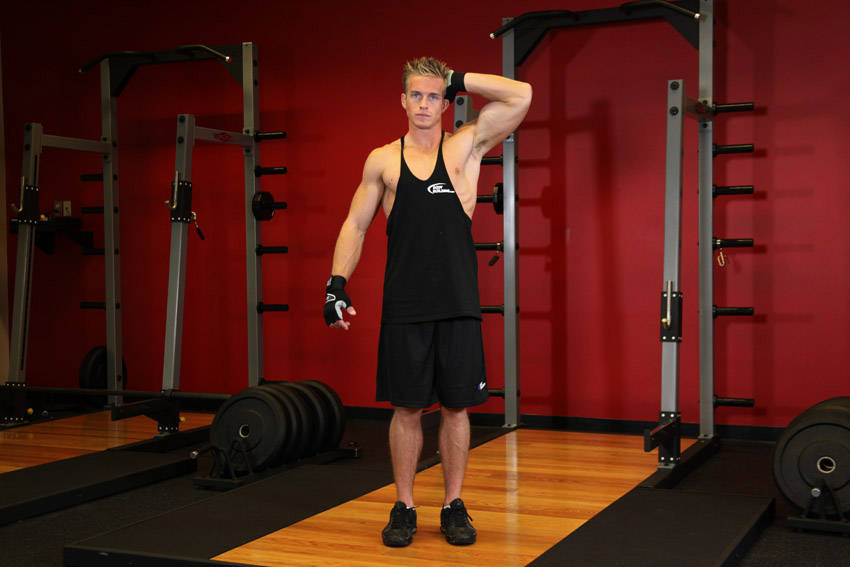

The neck side flexion, also called the lateral neck raise, is a simple bodyweight movement that strengthens the muscles responsible for tilting your head toward your shoulder. You perform it lying on your side, lifting your head against gravity, then lowering under control. It is a Pull-pattern exercise that isolates the neck and is friendly to beginners since the load is just the weight of your head.
Strong lateral neck flexors support posture, help stabilize the head during contact sports and combat sports, and may reduce strain from long hours at a desk. Because the neck is small and easily overloaded, this exercise rewards slow, controlled reps over heavy effort.
How to do the neck side flexion
- Lie on your side on a bench or the floor, legs stacked or staggered for stability, and rest your head in a neutral, in-line position with your spine.
- Support yourself with your bottom arm and keep your top hand on the floor or your hip; you can place a folded towel under your head for comfort.
- Brace your torso and exhale as you slowly raise your head straight up toward the ceiling, flexing the neck sideways without rotating or jutting your chin.
- Lift only as far as your neck moves comfortably, pausing for a beat at the top of the range where you feel the side of your neck working.
- Inhale and lower your head back toward the floor under full control, resisting gravity the entire way down rather than letting it drop.
- Complete all reps on one side, then roll over and repeat on the opposite side to balance both lateral flexors equally.
- Keep the movement isolated to the neck throughout: your shoulders and torso stay still while only the head moves.
Muscles worked
The primary muscle worked is the neck, specifically the lateral flexors that tilt your head toward your shoulder. The lead mover is the sternocleidomastoid (SCM), the prominent strap-like muscle running from behind the ear to the collarbone, which contracts on the top side to pull the head up against gravity. The scalenes, deeper muscles along the side of the neck, assist the lateral tilt and help stabilize the cervical spine. The small suboccipital and splenius muscles contribute to control and fine head positioning. Because you train one side at a time, this movement also exposes and corrects left-to-right strength imbalances, building symmetrical neck stability.
Benefits
- Builds lateral neck strength that supports head stability in contact and combat sports
- Trains each side independently so you can correct left-to-right neck imbalances
- Requires zero equipment, making it easy to do at home or as a finisher
- Strengthens muscles that support upright posture and resist desk-related neck strain
- Beginner-friendly load (just your head's weight) with a low barrier to entry
Common mistakes
- Rushing the reps: slow down and use a 2-3 second lower so the muscle, not momentum, does the work.
- Lifting too high or forcing range: stop where the neck moves comfortably to avoid straining the cervical spine.
- Jutting the chin forward or rotating the head: keep the chin neutral and move straight up so you isolate side flexion.
- Letting the head drop on the way down: control the eccentric every rep instead of relaxing into gravity.
- Training one side and skipping the other: always match reps on both sides to keep the neck balanced.
- Using a load that's too heavy too soon: master bodyweight reps before adding any hand or plate resistance.
Form tips
- Keep your head, neck, and spine in one line at the start so the movement begins from neutral.
- Move slowly and deliberately; the neck responds best to controlled tempo, not speed or heavy weight.
- Place a folded towel under your head for comfort and to cushion the bottom of each rep.
- Breathe out as you lift and in as you lower to stay braced and avoid holding tension in the jaw.
- Always train both sides with equal reps so the lateral flexors develop symmetrically.
Sets & reps
A sensible default for the neck side flexion is 2 sets of 12-15 reps per side with about 45 seconds of rest, training each side equally. For general endurance and joint health, stay in the higher 12-20 rep range with bodyweight and a slow tempo. For building strength, you can progress to 8-12 controlled reps per side, optionally adding very light hand resistance or a small plate held against the head once bodyweight feels easy. Because the neck is delicate, prioritize control and full range over load, train it 2-3 times per week, and stop any set the moment form breaks down or you feel pinching rather than muscular effort.
Frequently asked questions
What muscles does the neck side flexion work?
It primarily targets the neck's lateral flexors. The sternocleidomastoid (SCM) is the main mover, pulling your head up toward the ceiling, while the scalenes assist and the smaller splenius and suboccipital muscles help control and stabilize the cervical spine. Training one side at a time also balances left-to-right neck strength.
Is the neck side flexion safe for beginners?
Yes. It is a beginner-friendly bodyweight exercise that uses only the weight of your head, so the load is light. The key is slow, controlled reps within a comfortable range. Avoid forcing the head too high, keep the chin neutral, and stop if you feel any pinching rather than muscular effort.
How many sets and reps should I do?
Start with 2 sets of 12-15 reps per side, resting about 45 seconds, and always match reps on both sides. For endurance, stay in the 12-20 range with bodyweight. To build strength, drop to 8-12 reps and add light resistance only once bodyweight feels easy. Train it 2-3 times a week.
How is neck side flexion different from neck curls or extensions?
Side flexion tilts the head sideways toward the shoulder, training the lateral flexors like the SCM and scalenes. Neck curls (flexion) lift the chin toward the chest to work the front of the neck, and neck extensions lift the head backward to train the rear. A complete neck routine includes all three planes.
Do I need any equipment for the neck side flexion?
No. It is a pure bodyweight movement; the weight of your head provides resistance. A bench or the floor and an optional folded towel for comfort are all you need. Once bodyweight reps become easy, you can add light hand pressure or a small plate held against the side of your head to progress.
Why should I train both sides equally?
Because side flexion is a unilateral movement, training only one side can create a strength imbalance that affects posture and head control. Performing matching reps on each side ensures both lateral flexors develop evenly, which is especially important for athletes in contact or combat sports where balanced neck strength protects against injury.